My internship here at Corkscrew Swamp Sanctuary is coming to a close within the next two weeks, and accordingly, this will be my last blog post. Almost 6 months has elapsed since my internship started here, and it's simultaneously felt like a lifetime and a split second in time. It seemed there was no one singular post to leave on, so I wanted to talk about some highlights of my experience here at Corkscrew and Southwest Florida. Let's get sentimental.
I arrived at Corkscrew on September 5, 2017, just 5 days before the most powerful hurricane ever recorded in the Atlantic Basin made landfall south of Naples. The destruction it wreaked on Corkscrew and Naples has been fleshed out enough, but from my end of things it was a once in a lifetime experience that I honestly wish to never experience again. I stayed here at Corkscrew through Irma, and sheltered in the Blair visitor center. As the eye wall passed over the Blair center on September 10, I will never forget seeing the hurricane rip through the pine flatwoods surrounding the visitor center. An entire forest of Slash Pine and Cabbage Palm in fluid motion bent and swayed westward with each band of wind and pouring rain, yet the chaos outside was muted by the thick concrete walls and high-impact resistant windows that enclose the Blair Center. There was nothing quite like pulling a chair up to the door and watching one of the most powerful forces of nature that exists tear through Corkscrew.
I'll also never forget the following month, where every day was spent out in the late Summer heat clearing Cypress needles and branches stripped by Irma off of the boardwalk and clearing Corkscrew's facilities of enormous Slash Pines that had finally succumbed to the +100 mph winds. For a brief moment at Corkscrew, all of the staff, each with their own respective backgrounds and department priorities, came together to accomplish one mission: recovery.
Another memory of type 2 fun came from my first non-boardwalk related work activity when I joined the Research department to complete our first week of aquatic fauna surveys at Panther Island and at Corkscrew. It was my first introduction to wildlife surveying, and my first week spent entirely knee deep in the swamp. The humidity, the scorching sun, and the monotony of the sampling process itself couldn't sour seeing the most beautiful sunrises through the fog and mist shrouding stands of Slash Pine and a purple sea of blooming Muhly Grass. I ventured into a cypress dome for the first time as a part of our survey area, and stood in a small pond in absolute awe looking up at ancient cypress trees with sheaths of resurrection ferns draping the upper branches, listening to woodpeckers make a ruckus.
I can't also forget when in the process of driving a swamp buggy with Resource Manager Allyson Webb at Panther Island, one of the front tires of the buggy popped off of its axle and floated away in a puddle in the road as we sat in a state of shock that quickly developed into a moment of serious laughter.
Naturally, I will also never forget the sheer beauty of Corkscrew, primarily from a plant community perspective. Standing out on the exit boardwalk during the sunset and looking north over the wet prairie where 3 main ecotones of swamp ecosystems coincide, and waiting for the same group of Black Bellied Whistling Ducks to settle into the marsh to forage during the evening was a favorite sight of mine. Watching the sunset filter its last golden beams over the Pond Cypress and wet prairie and into the pines around Plume Hunter's camp was pure magic every time. Lest I forget about the enormous stretches of blooming wildflowers at Panther Island that shifted at the interchange of the wet and dry season seasons, or standing in the pine flatwoods to the south of the visitor center and hearing the wind whip through the upper canopy of the Slash Pines and feeling it gently filter down into the understory of saw palmetto, wax myrtle, and salt bush.
In my 6 months here, I feel like I saw something new and spectacular every day. It wasn't necessarily earth-shattering stuff, like seeing a panther (which finally happened just this week) or seeing the most spectacular sunset in my lifetime. Each day, I learned something new about wildlife behavior, the ecosystems of South Florida, plant phenology and reproduction, or shared a new experience with a coworker. Corkscrew in its abstract sense is a spectacular place, but the people who work here at the Swamp add a special human component to it. I learned so much about resource management techniques, equipment maintenance and repairs, and large-scale research projects operating on grand temporal scales. I met some amazing volunteers who took time out of their day to teach me something new or even show me a new experience entirely like when Ralph Arwood took me down to Big Cypress to help him with his acoustic bat monitoring project.
All these mushy platitudes aside, what made this experience particularly enjoyable for me was that it was so warm here the entire duration of my internship. I strongly detest winter and being cold in general, and spending the winter months here at Corkscrew gave me a sweet sense of satisfaction and gratitude for rarely if ever having to bundle up into multiple layers of clothes.
I will definitely be sad to leave here the first weekend of March, but I am excited for what is to come. In April, I will be starting a new job at Hot Springs National Park in Arkansas as a seasonal resource management technician performing a host of different duties. I am absolutely certain that if it were not for my experience and time here at Corkscrew, I would not be gaining this sort of employment with an agency I have been trying to work with since graduating college.
To all my coworkers I've had the privilege of working with- thank you for your guidance, willingness to teach, and most importantly your sense of humor. To all the alligators out in the swamp- I love you all. Each and every one of you are amazing creatures. And to my friends living in the Gatorhole intern dorm- it was too real. Peace.
-Hayden (conservation intern)

Friday, February 16, 2018

Wednesday, February 14, 2018
New Conservation Intern
Hello my name is Melissa Gonzalez and I am Corkscrew's newest Conservation Intern. I was born and raised in Queens, NY where I explored the concrete jungle in my formative years. At age 11 I moved to Naples, FL and this city girl was suddenly stuck in a small town. As I grew into my teenage years I began to explore this small town that I was thrown into. Instead of taking the subway or walking through the city, I was climbing trees, running through pine flatwoods, and spending hours at the beach. Growing up in Naples I grew to love the outdoors because there wasn't much else to do but spend time outside. I had visited Corkscrew a few times through school field trips, and had always been enchanted during my visits to this mystical swamp. Walking through the board walk and seeing the cypress dome in front of me was fascinating when I visited the first time, and I still feel the same 10 years later.

I graduated from the University of Central Florida in December 2017 with a B.S in Environmental Studies, and a minor in Biology. GO KNIGHTS! (Charge On). Since I was a little girl, I knew I wanted to work with animals, and with my experiences growing up in Naples, that passion for wildlife just grew. Since I started my college career I planned on pursuing a career in conservation/wildlife biology. Throughout my 5 years at UCF I have had the privilege to work for some great organizations, which reassured me that a career in conservation is what I wanted to pursue. I worked with 3 species of sea turtles in the Archie Carr Wildlife Refuge for the summer months of 2015 as an intern for the UCF Marine Turtle Research Group. Working with Marine Sea Turtles was truly an amazing experience, I got to gain valuable knowledge/experience handling wildlife. That same summer I did Red-Cockaded Woodpecker surveys, and spraying invasive plant species at the Ocala National Forest. The following summer, I went on a cross-country road trip to Portland, Oregon so that I could work for the Mt. Hood National Forest as an Interpretive intern for summer of 2016. Through that internship I grew to love teaching the public about our wildlife and our forests, also hiking in the PNW is now my favorite thing to do.


I first got introduced to Audubon when I got accepted into Audubon Florida’s “Conservation Leadership Initiative" my sophomore year of college, and 4 years later I am still involved with the program. Through CLI I got involved with Orange Audubon Society, the local Audubon chapter in Orlando all with the help of my mentor Deborah Green. I have been on the OAS board for the past couple years, and have been able to bird with some of the best birders because of our field trips. The past 2 years I have started to appreciate birds more and have been intrigued with them. I have managed to become a decent birder, and I hope to get better with my time here at Corkscrew. With these internships under my belt, I look forward to all the new experiences I will have at Corkscrew Swamp. I had an eventful first week here in the swamp, I got ATV training, got to assist in my first prescribed burn and I got to follow around a national geographic photographer while he got footage of Kelsie and Mica doing the conservation work we do. This is my third week here and I am already loving what I do. Hayden, Kelsie, and I had fish sampling this week so I finally got a taste of what the research work is. The jobs I will be required to do here at Corkscrew are ones that I have never done in previous internships, so I am thrilled to gain all this new knowledge during my time here. I also look forward to exploring all the unique habitats that SWFL has to offer with my Corkscrew roommates Kelsie, Hayden, and Shelby. I will be here until mid July, so I look forward to telling you stories from my perspective at the swamp!

-Intern Melissa
Friday, February 2, 2018
2nd grade Insect Adventure!
In the education department, the past month has been all about our 2nd graders here at Corkscrew. In school they're learning about the parts of an insect, how they function, what they eat, and what their role is in the world. They get to apply what they have learned in school when they come out to the sanctuary, and they sure do love being here and walking through our woods.
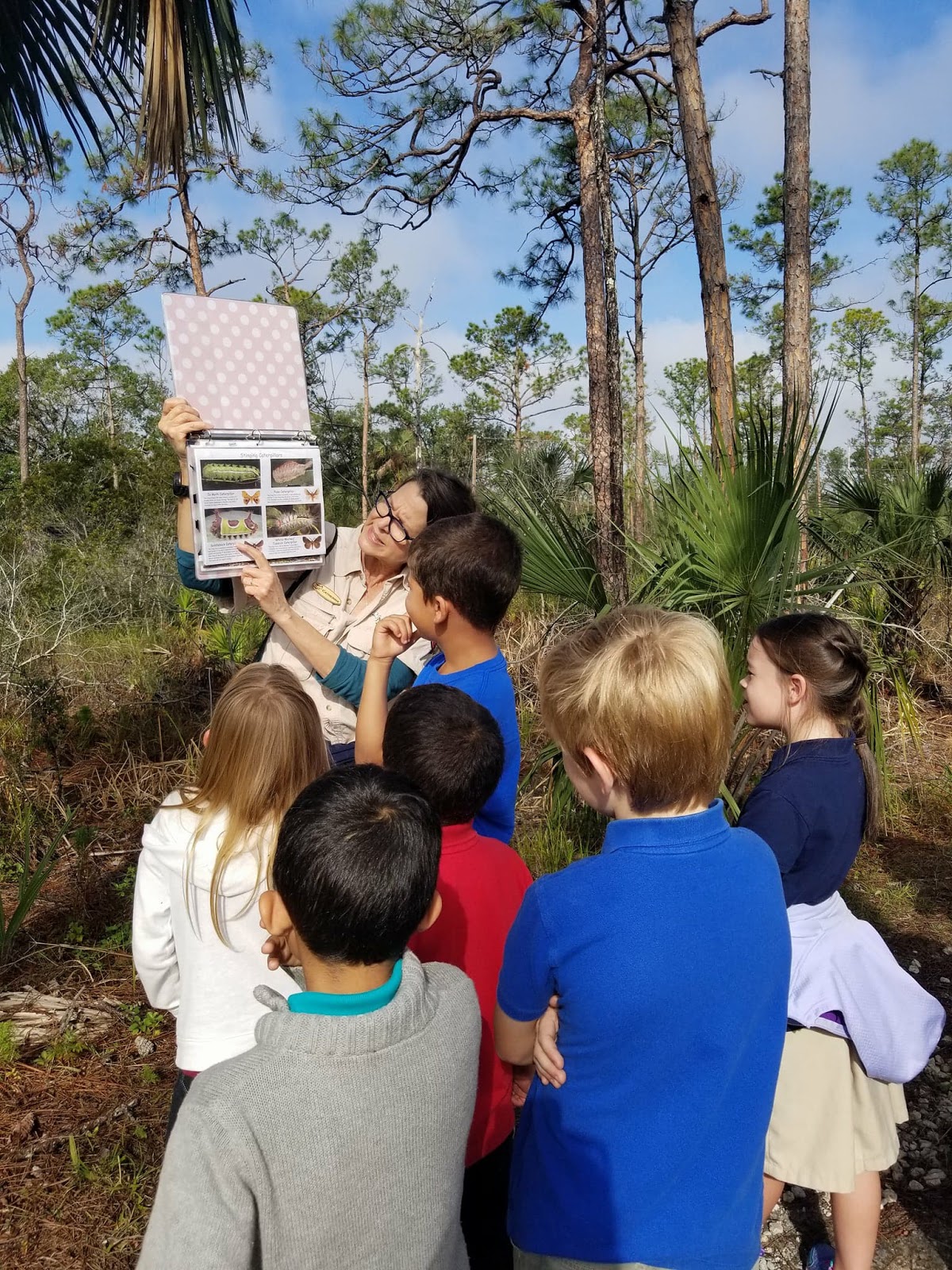
They are always excited when they find a new butterfly, or even a simple ant pile can be thrilling for them. We do our best to identify whatever they find for them.

Our dipnetting station is a huge hit with the kids. We let them examine some of our pond critters up close and personal. We tend to find a ton of fish, crayfish, whirligig beetles, shrimp, frogs, and even snakes!

Another interesting station that the kids get really into is our "Amazing Antlion" station. Antlions, also called "doodlebugs" are larvae that create little funnel-shaped pit traps. They wait at the bottom of the trap for ants to slide into the pit and then the feast begins!

Coming across this wild boar carcass was a huge surprise to these kids. They actually handled it really well and I was so impressed! You never know how they are going to react to "gross" things like that. We think it's important to be open with the kids about what they may find out in the woods, and this boar was no exception. We talked about all the creepy crawlies that may have helped break this guy's body down.

It's really great seeing these 2nd graders getting really into their young entomologist roles when they visit. I love being apart of this and teaching them about how beneficial insects can be for us!
Until next time!
-Intern Shelby
Tuesday, January 23, 2018
Fall at Corkscrew

When moving to southwest Florida, I did not expect to see a typical fall; no colors, and no cooler weather. It is now January and many people are experiencing winter with temperatures throughout the Midwest ranging from 35° F to 0° F, and my home town in southern California a brisk 68° F; meanwhile here in Naples, Florida, the real feel today was 80° F. After hurricane Irma came through and wind stripped the needles and leaves off many of the trees, I was then SURE I wouldn’t see a fall this year, but boy was I wrong. Although this warm weather is not a typical fall characteristic, this week has also brought in some GORGEOUS colors from the Cypress and Maple trees!


Many people associate coniferous trees with evergreens such
as Slash Pine, Ponderosa Pine, or any of your go to Christmas tree species. Although
Bald Cypress trees are coniferous, they are also deciduous meaning they lose
their needles once a year - these classifications are mutually exclusive. This
year being a unique year with the Cypress losing their needles in September (a
little before they usually drop their needles), something has been signaling them
recently to just now start changing colors, and I love it!
(The same stand of cypress in November (above) and January (right)).
The reds and oranges are flowing through the cypress dome
and create a whole new feel while exploring Corkscrew. These warm colors bring a
new dynamic to the mostly green landscape we are now used to seeing here in the
swamp. What a beautiful surprise, I guess southwest Florida does experience its
own version of fall!
-Kelsie
Tuesday, January 16, 2018
Melaleuca quinquenervia: South Florida's Public Enemy #1
Over the course of the last few weeks, I have been in the backcountry of Corkscrew treating a variety of invasive species. One particular species rests at the top of Corkscrew resource management's invasive species hit list. This particular invasive tree not only plagues landscapes locally at Corkscrew, but has an extensive and dense range throughout South Florida. The perpetrator of South Florida environmental degradation highlighted here-- Paper Tree (Melaleuca quinquenervia)-- has dramatically changed the landscapes of South Florida and affected both plant and animal communities in its wake.
 Paper tree, like most invasive species I have come across in my land management experiences, is a fairly attractive plant, with birch-like white bark and large clusters of creamy white flowers that resemble caterpillars latching onto the ends of the upper canopy. The narrow, lance-shaped leaves hang from stems in an alternating pattern, forming a pleasant array of grayish green foliage. In its native Australia, Paper Tree is a prized tree species that is valued by bee-keepers, used frequently in landscaped parks, and is a focal species for some areas' conservation efforts. Here in Florida, though, Paper Tree displaces native vegetation as a result of the tree's prolific seed production that can quickly establish large, impenetrable monocultures. These massive stands of Paper Tree additionally displace the native fauna that have evolved to depend on the shelter and food that native plants provide.
Additionally, Paper Tree is changing the hydrology of South Florida ecosystems. The tree is able to most effectively colonize areas that contain peat soils and have a short hydroperiod (i.e. seasonal water inundation lasts only a short time). As the trees proliferate and grow taller, the continual shedding of leaves and bark creates more organic material that filters into the forest floor, creating more upland habitats and effectively drying out large areas of land.
Paper Tree also changes South Florida's fire behavior. When Paper Tree invades habitats like sawgrass prairies, freshwater marshes or hardwood bottomlands that have evolved and adapted to a consistent fire regime, the amount of surface level fuels available for a fire to burn dramatically increases. The increase in surface fuels (i.e. leaf litter and bark from the tree), combined with the volatile organic compounds found in the tree's leaves, create fires that burn at much higher than normal temperatures, causing greater occurrences of crown fires and tree/plant mortality.
Treatment of Paper Trees is estimated to cost the state of Florida somewhere around $2 million annually. The potential economic damage of unchecked Paper Tree infestations across South Florida is estimated to total in excess of $100 million, largely harming tourism industries linked to South Florida's public lands. Here at Corkscrew, Paper Tree is routinely patrolled for and treated with chemical methods. For as much environmental and economic damage it does, it was an especially satisfying feeling heading into the pine flatwoods at CSS and putting a halt to the spread of this sinister invasive species.
-Hayden (Conservation Intern)
Friday, December 29, 2017
Monthly Bird Survey & 118th Annual Christmas Bird Count
One of my favorite things about being an Intern at Corkscrew is getting to participate in bird surveys. What a surprise from the bird nerd, right? As school children are on break from field trips to Corkscrew, I get to do what I love to do on my break too - go birding!
Myself, two of our education staff members, and a seasoned volunteer hiked through a variety of different habitats from pine-palmetto flatwoods, through the wet prairie, and into the cypress swamp where we ended up thigh-deep in water.

One of the more interesting species that we found during our on-site survey in late December was the Wilson's snipe. We were walking through the pine flatwoods and to our surprise, we flushed 12 snipes from their hiding spot. It was very exciting as I have never seen one in the wild. That's a lifer for me!
Some of our higher numbers came from the following species:
wood stork (14)
red-bellied woodpecker (16)
back vulture (22)
palm warbler (44)
tree swallow (80)
The tree swallows are wintering here in Florida and it is not unusual around this time to see a large group of them darting around like flying acrobats catching up insects - thanks guys! Come anytime.
We were also very happy to see some wood storks. They are hopefully settling in and getting ready to nest soon, and I sure love baby wood storks.
Not only do we do our own bird surveys here on-site every month, but I also captained two different teams for Audubon's 118th Christmas Bird Count. What an honor!
As climate change is a huge concern these days, declining bird populations hits close to home. The data gathered from the Christmas Bird Counts around the United States is used by researchers, conservationists, and government agencies to study and ensure healthy population numbers for the future of these birds.
For the Corkscrew Bird Count, between 14 teams we tallied a total of 120 different species of birds, and a whopping 14,101 birds total recorded for the day - incredible!
Some notable numbers:
wood stork numbers were up from last year - 421 up from 200
8 bald eagles tallied total
7 northern bobwhites were spotted - which is the first time recorded on a CBC since 2011
and a popular favorite, the roseate spoonbill was counted 114 times
All in all, it was a beautiful day of birding. If you are interested in participating in a Christmas Bird Count next year near you, you can read more information about it here.
-Shelby (Education Intern)
 |
| It was a really foggy morning to start! |
Myself, two of our education staff members, and a seasoned volunteer hiked through a variety of different habitats from pine-palmetto flatwoods, through the wet prairie, and into the cypress swamp where we ended up thigh-deep in water.

One of the more interesting species that we found during our on-site survey in late December was the Wilson's snipe. We were walking through the pine flatwoods and to our surprise, we flushed 12 snipes from their hiding spot. It was very exciting as I have never seen one in the wild. That's a lifer for me!
Some of our higher numbers came from the following species:
wood stork (14)
red-bellied woodpecker (16)
back vulture (22)
palm warbler (44)
tree swallow (80)
The tree swallows are wintering here in Florida and it is not unusual around this time to see a large group of them darting around like flying acrobats catching up insects - thanks guys! Come anytime.
We were also very happy to see some wood storks. They are hopefully settling in and getting ready to nest soon, and I sure love baby wood storks.
Not only do we do our own bird surveys here on-site every month, but I also captained two different teams for Audubon's 118th Christmas Bird Count. What an honor!
As climate change is a huge concern these days, declining bird populations hits close to home. The data gathered from the Christmas Bird Counts around the United States is used by researchers, conservationists, and government agencies to study and ensure healthy population numbers for the future of these birds.
For the Corkscrew Bird Count, between 14 teams we tallied a total of 120 different species of birds, and a whopping 14,101 birds total recorded for the day - incredible!
Some notable numbers:
wood stork numbers were up from last year - 421 up from 200
8 bald eagles tallied total
7 northern bobwhites were spotted - which is the first time recorded on a CBC since 2011
and a popular favorite, the roseate spoonbill was counted 114 times
All in all, it was a beautiful day of birding. If you are interested in participating in a Christmas Bird Count next year near you, you can read more information about it here.
-Shelby (Education Intern)
Friday, December 22, 2017
'Tis the Season...
... for the Wood Storks!
We are starting to see Wood Storks in the area, and are anxiously awaiting their nesting. This once endangered indicator species is now the focus of many conservation efforts statewide.
Here at Corkscrew, we have a few different surveys geared towards Wood Storks. Our very intensive fish sampling days are intended to document the prey base for many wading birds, including the Wood Stork. For these surveys, we document the amount of fish, diversity of fish (how many different species there are), and mass of the fish in a given area. These surveys are completed throughout the dry-down period when fish start to conglomerate in the few pools of water that remain throughout the dry season.
Just recently, we completed our first flight for the season over parts of southwest Florida to monitor Wood Stork nesting. I have never flown in anything besides a commercial aircraft, so the small 4 person Cessna was quite a shock! The days leading up to the flight were filled with anticipation. I have heard friends, colleagues, and professors talk about some of the good and bad things about flight surveys. A stomach of steel is highly desired, but most people don’t know if they have one or not, until their first flight. So this was going to be the day that I found out if aerial surveys were in my future.

I prepared by bringing light snacks to eat when going from point to point, and a Sprite to settle my stomach in case I was to find out I don’t have that desired “stomach of steel”. I was also told that it usually gets really warm in the air but when we open the windows to take pictures we get some nice fresh air. Well, this seemed to be a very atypical flight for Southwest Florida. We got to the Naples Airport by sunrise and the temperature was still in the 40’s! Luckily I was prepared for cold weather, I had my ski socks on, a long sleeve and sweatshirt, but I still needed more! Once we got up in the air and opened the windows, as promised, the cold wind came in to the already cool aircraft, and now we were freezing. Luckily the 360 degree views surrounding us were a great distraction.
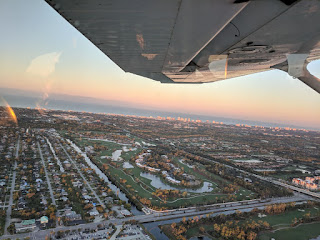
After rows and rows of houses and development, suddenly we came to an island of Cypress and greenery. We saw marsh, pines, cypress, and finally the boardwalk, with no houses to be seen. It was such a wonderful sight- a sight I’m sure would have been even more amazing years ago when this island of greenery was more like an ocean. But for now, the island of protected lands managed and cared for by many different agencies and organizations will suffice.

We traveled to different predetermined points from the Caloosahatchee River to Corkscrew. Once we got to a point, we would circle the area to determine if there was any Wood Stork activity and if there was where they were located. At our first point of the day, we found Wood Storks high in the canopy of the Cypress. I was amazed at the ease of seeing these majestic birds – seemingly unbothered – from the air. We locked down on the storks circling tighter to get the best, closest, clearest pictures possible while almost sitting parallel to the earth’s surface and bouncing around in the wind.
Once we got the OK that the photos came out clear enough, we were on to the next 4 more points. The views were always changing, back into civilization, then over water, circling small desert islands, watching Great Blue Herons flush from one island, and Great Egrets continue their day on another. But one thing was constant; the turbulence. The bouncing around and prolonged periods of circling one area led to a feeling in my stomach that was not promising.

After an hour and a half of going from point to point, circling many different areas, it was time to go back to the airport. On the way back, the pilot took us up higher where the air was calmer leading to a more pleasant flight. Through our headset I heard the pilot say, “that was a rough flight! That felt like flying in New England, not Florida!” Hearing this, I have hope that the next flight will be even better, and maybe I don’t have a stomach of steel, but maybe it’s not too bad.
What's next on the adventure?
-Kelsie (Research Intern)
We are starting to see Wood Storks in the area, and are anxiously awaiting their nesting. This once endangered indicator species is now the focus of many conservation efforts statewide.
Here at Corkscrew, we have a few different surveys geared towards Wood Storks. Our very intensive fish sampling days are intended to document the prey base for many wading birds, including the Wood Stork. For these surveys, we document the amount of fish, diversity of fish (how many different species there are), and mass of the fish in a given area. These surveys are completed throughout the dry-down period when fish start to conglomerate in the few pools of water that remain throughout the dry season.
Just recently, we completed our first flight for the season over parts of southwest Florida to monitor Wood Stork nesting. I have never flown in anything besides a commercial aircraft, so the small 4 person Cessna was quite a shock! The days leading up to the flight were filled with anticipation. I have heard friends, colleagues, and professors talk about some of the good and bad things about flight surveys. A stomach of steel is highly desired, but most people don’t know if they have one or not, until their first flight. So this was going to be the day that I found out if aerial surveys were in my future.

(Hopping aboard our aircraft)
I prepared by bringing light snacks to eat when going from point to point, and a Sprite to settle my stomach in case I was to find out I don’t have that desired “stomach of steel”. I was also told that it usually gets really warm in the air but when we open the windows to take pictures we get some nice fresh air. Well, this seemed to be a very atypical flight for Southwest Florida. We got to the Naples Airport by sunrise and the temperature was still in the 40’s! Luckily I was prepared for cold weather, I had my ski socks on, a long sleeve and sweatshirt, but I still needed more! Once we got up in the air and opened the windows, as promised, the cold wind came in to the already cool aircraft, and now we were freezing. Luckily the 360 degree views surrounding us were a great distraction.

(An aerial view of Naples development)
After rows and rows of houses and development, suddenly we came to an island of Cypress and greenery. We saw marsh, pines, cypress, and finally the boardwalk, with no houses to be seen. It was such a wonderful sight- a sight I’m sure would have been even more amazing years ago when this island of greenery was more like an ocean. But for now, the island of protected lands managed and cared for by many different agencies and organizations will suffice.

(The island of protected land, green for as far as the eye can see)
We traveled to different predetermined points from the Caloosahatchee River to Corkscrew. Once we got to a point, we would circle the area to determine if there was any Wood Stork activity and if there was where they were located. At our first point of the day, we found Wood Storks high in the canopy of the Cypress. I was amazed at the ease of seeing these majestic birds – seemingly unbothered – from the air. We locked down on the storks circling tighter to get the best, closest, clearest pictures possible while almost sitting parallel to the earth’s surface and bouncing around in the wind.
Once we got the OK that the photos came out clear enough, we were on to the next 4 more points. The views were always changing, back into civilization, then over water, circling small desert islands, watching Great Blue Herons flush from one island, and Great Egrets continue their day on another. But one thing was constant; the turbulence. The bouncing around and prolonged periods of circling one area led to a feeling in my stomach that was not promising.

(A small island in the Caloosahatchee with what was though to be nesting Great Egrets)
After an hour and a half of going from point to point, circling many different areas, it was time to go back to the airport. On the way back, the pilot took us up higher where the air was calmer leading to a more pleasant flight. Through our headset I heard the pilot say, “that was a rough flight! That felt like flying in New England, not Florida!” Hearing this, I have hope that the next flight will be even better, and maybe I don’t have a stomach of steel, but maybe it’s not too bad.
What's next on the adventure?
-Kelsie (Research Intern)
Subscribe to:
Posts (Atom)