Tuesday, October 23, 2018

Things that go bump in the night

It was a cloudy, windless night. The only sources of light came from the nearly full moon filtering dimly through the cypress trees, and our headlamps bouncing along the boardwalk. The shrieks of caterwauling Barred Owls echoed eerily through the swamp, and the light pattering of falling cypress needles sounded like soft rain all around us.


As we scanned the swamp with our headlamps, we saw that we were surrounded by hundreds of tiny pinpricks of light. Some of these reflections, we discovered, were frog eyes, which frequently disappeared with a loud "SQUEAK" and a plop into the water.

One of the many Cuban Treefrogs we encountered
However in an unexpected turn of events, many more of these iridescent pinpricks turned out to be spiders! And big ones, at that.

Fishing spider with an egg sac
The strangeness continued as we passed through one of the rain shelters and found a round, fluffy object with a feathered tail nestled in a corner of the ceiling. We stared in shock and bewilderment for several seconds before realizing that it was a bird (a Carolina Wren, to be exact). But what was it doing? Is that how birds sleep? We were making quite a lot of noise -- why didn't it wake up and flee?


It turns out that dozing beneath the cover of these rain shelters is fairly common practice for the Carolina Wrens that inhabit Corkscrew. As we continued on our nighttime escapade, nearly every shelter that we came across contained at least one fluffed up wren snoozing the night away, seemingly oblivious to the curious humans blundering about beneath them.

Among the frogs and the spiders and the birds, we also bumped into a few other critters in the night, including some elusive geckos, a surprised raccoon, and even an opossum staring inquisitively down at us from its perch up in a tree.

With Halloween fast approaching, it's easy to get into the spirit of wandering the swamp after dark. Who knows what unexpected things we may find next time?

~Lara

Tuesday, October 9, 2018

An Unexpected Friend

         This last week working with the Corkscrew Swamp Research team I went into a portion of the swamp deemed the Central Marsh Transect (CMT), a location frequently sampled for wetland fishes. The crew had gone out the previous day and set minnow traps. Minnow trapping is an especially interesting type of fish sampling as it requires placing several traps that have a variety of large and small sized mesh around the area being sampled. The traps have two sides that act as funnels, allowing fish and other wetland invertebrates inside, but preventing their escape. The traps are placed either completely or mostly underwater and are left there for 24 hours before their removal.
         As we began our task of finding and collecting the previously set minnow traps, it seemed like an average day. Several traps were empty, while some contained Crayfish and/or Mosquito fish. Little did we know, our last few traps had quite the surprise in store for us. As we reached the wet prairie we pulled up a minnow trap that had been set by some Alligator Flag, and in it was a small brown and black snake! I had never seen a snake get caught in one of these traps, or even seen many wild snakes. I was elated that we had such a good trap!


         At first my partner and I were nervous to touch it and were unclear what to do with it now that we had caught it. Luckily another crew member quickly identified the snake as a Banded Water Snake (Nerodia fasciata). She then opened the trap and began to investigate whether the snake would be too upset with us to be handled. The little snake seemed unbothered, and without another question I leaped at the opportunity to hold my first wild snake! The little snake was so calm as he crawled up onto my arm. We proceeded to measure his body length before setting him free back into the wet prairie. We then continued about our tasks of collecting the remaining minnow traps. Overall though, I must say, it was a very successful day in the swamp!I can't wait until I get to run into one of these little friends again!

- Evan, Conservation Intern

Friday, October 5, 2018

Mimicry in the Swamp

In the spirit of October and the impending dress-like-your-favorite character/star/dog/fruit day, let’s talk about mimics at Corkscrew, of the non-human animal variety. I typically don’t think about Halloween until the day after (when all the candy is on sale, duh), but this gives me a good excuse to talk about evolutionary strategies, and no one in their right mind would pass up an opportunity like that … right??
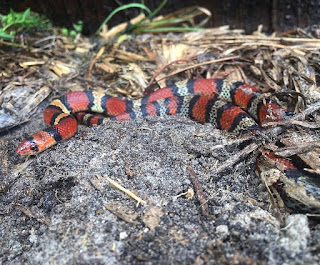

Cemophora coccinea coccinea (Photo Credit: Lee Martin)
So let’s get to it. Most people can think of an example of mimicry, like the palatable Scarlet Kingsnake (Lampropeltis elapsoides) or Florida Scarlet Snake (Cemophora coccinea coccinea) mimicking the coloration of the unpalatable Eastern Coral Snake (Micrurus fulvius) to avoid predation. Mimicry is an evolutionary tool employed by some animals, both prey and predator species alike, to either avoid predation or, in the case of predators, lure prey into a false sense of security to make predation more successful. But what makes a mimic a good mimic? Is there such thing as a bad mimic, or are there situations where a bad mimic is still effective? A good mimic, in theory, would closely resemble the harmful species, or model, with mimetic advantage decreasing as similarity to the model decreases. 
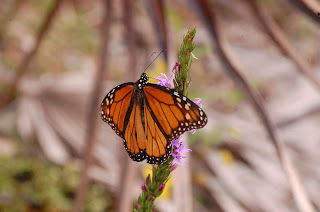
Model Danaus plexippus (PC: Lee Martin)
There are two common types of mimicry, Batesian and Müllerian. In Batesian mimicry, the palatable or harmless species mimics the harmful model to trick predators into thinking it is also harmful. In Müllerian mimicry, both mimic and model are unpalatable and develop similar physical traits to benefit from shared protection. Monarch (Danaus plexippus) and Viceroy (Limenitis archippus) butterflies are 
Müllerian mimic Limenitis archippus (PC: Lee Martin)
an example of this, because both are toxic and therefore unpalatable to potential predators. Regardless of the type of mimicry, mimics must be sympatric to models (occur in the same areas) to benefit from their protection. There must also be a sufficiently high frequency of models to mimics, so that predators have enough experience with the dangerous model to reinforce aversion to the warning signal. Otherwise, predators learn that the warning signal is a ploy, and there is no longer any mimetic advantage. However, there are always situations that bend the rule.

Many mimics have ranges that extend beyond that of their model, and individuals that exist in these areas are called allopatric mimics. Müllerian mimics are still harmful without a model, so aposematic (warning) signals would remain an effective strategy in allopatry. Batesian mimics do not have this protection, but may still benefit from mimicry when predators have an innate aversion to the mimicked trait, or if the trait has some other selective advantage such as enhancing crypsis or increasing resource acquisition. Finally, some predators that have large home ranges may come into contact with the harmful model where mimics are sympatric, and thus still avoid mimics in areas where the model is not present.

Many animals at Corkscrew display mimicry, from Scarlet Kingsnakes to Viceroys. Discovering the mechanisms that cause such phenomenon to occur is fascinating and remains somewhat speculative in nature. There is much we have yet to learn about these evolutionary processes, and the best thing? It’s happening right in our backyard!  

- Randi Bowman, Research Intern

Thursday, September 27, 2018

Corkscrew Reflections

It's hard to believe that I only have a little under a month left here at Corkscrew. When I look back on everything that's happened these last few months, it amazes me just how quickly the time has flown, and how much I have learned.

It was a little overwhelming at first, trying to learn so many new plant species, not to mention trying to get used to working outside in Florida's heat and humidity. While the heat can still be rough, I think I can say with confidence that I can positively identify many more invasive plants than when I first started. And of course, I've gained plenty of other new experiences as well, like riding in an airboat, and learning to drive an ATV and a swamp buggy. And the next two weeks, I'll be helping out the research team with their work as well.

Not every aspect of my time here as been about work either. Most evenings I spend some time walking along the boardwalk and just soaking in the ambiance of the nature around me.


 I've gotten to see some incredible things while I've been here, and of course it's always a privilege to get to live and work in such a beautiful area. I've even been lucky enough to see not only a panther, but several bobcats and even otters as well! And of course I never remembered to have a camera with me to actually get pictures of these incredible creatures.

In a few weeks, I'll be heading back home to Ohio. I don't know what's ahead for me, by I look forward to meeting it when it comes. And I know that I'll always look back fondly on all the things I leaned and experienced here at Corkscrew Swamp.

~Amanda

Tuesday, September 18, 2018

New Conservation Research Intern: Lara


Hi all! My name is Lara Jones and I am from northern New Jersey. I just graduated from Wellesley College in June with a degree in Biological Sciences and a concentration in ecology and conservation. I’ve been passionate about wildlife for as long as I can remember, and my drive to understand as much as I can about the outdoors while simultaneously striving to protect it has led me to pursue the long and winding path of becoming a field research ecologist. 
In particular, I am fascinated by behavioral ecology. Observing animals interacting with their natural environment is an incredible way to learn more about the natural world, and almost always leads to a myriad of questions and hypotheses. What I love most about behavioral ecology is the element of the unknown – when you’re watching an animal, there are so many different ways that it might choose to behave, and so even if you feel that you understand a species completely and can predict their every last move, there is always the exciting chance that one day you’ll be left completely and utterly baffled and with a million new questions.

As an undergraduate, I wanted to be as involved in ecological research as I possibly could be while enrolled in a small, liberal arts college. During my first couple of years I helped my professor transcribe the nesting behaviors of a pair of ravens who had decided to build their nest on top of the campus’s science center using video footage taken by a camera set up at the ravens’ nest. I then joined a different lab that focuses on ecosystems ecology for my last year of undergraduate, and I studied something totally different – the interactions between types of mycorrhizal fungi, soil texture, and tree root length.

While my research experiences during the academic year were critical for shaping my relationships with professors and honing my critical thinking and data analysis skills, it was really my summer research excursions that threw me head-first into the world of field ecology and made me realize what I did and did not like. After my second year of college, I traveled to Manitoba, Canada to be a volunteer field research assistant on a wolf movement ecology project.
I was really excited to work on this project because I have loved wolves since I was young, and I (erroneously) equated loving an animal to loving researching that animal. Although I enjoyed my time as a field tech, hiking through the prairie and boggy wilderness that is much of Manitoba, most of the work consisted of searching for and collecting samples of ungulate carcasses and wolf scat. I never got to actually observe wildlife in action, and after that summer I realized that I wanted to participate in field research which would allow me to more tangibly study animals.

This aspiration came true big time during my third year of undergraduate, when I studied abroad for a semester in South Africa through the Organization for Tropical Studies’ Ecology and Conservation program. Those three months were some of the best of my life, and are impossible to summarize accurately in just a few sentences. While traveling around different beautiful areas of the country, I assisted in ecological research projects on African wildlife, learned about conservation practices in national parks, and had a few close encounters with amazing animals such as leopards and African elephants.


All of these vastly different research experiences have contributed enormously to my field skills and understanding of what it means to be an ecologist. However, the work I did over the last two summers truly kick-started and began to shape my newfound and intense interest in… birds! Over the past two summers I worked as an avian field intern at the Hubbard Brook Experimental Forest in the White Mountains of New Hampshire. My first summer there, I designed and conducted a study to assess how birds are foraging in White ash trees in the forest in order to understand how avian communities will be impacted by the impending arrival of the invasive Emerald Ash Borer beetle, which has been killing ash trees as it spreads throughout North America.
I returned to Hubbard Brook this past summer as an intern with the Smithsonian to collect field data for a long-term study on the breeding population of Black-throated blue warblers that nest in the forest. While it isn’t particularly easy to find softball-sized nests in an expanse of trees with a dense understory, I absolutely loved this job because it involved using my knowledge of avian behavior to locate nests and then closely monitor their progress.
Through these internships, I’ve come to learn that birds are great subjects to use in studying behavioral ecology because, well, they’re everywhere, and they are also relatively easy to observe.

I’m thrilled to be working at Corkscrew this fall and winter, and am especially looking forward to getting to know all the different bird species and herpetofauna down here in the western everglades. Outside of field work, I really enjoy hiking, birding (duh), and reading fantasy/sci-fi books. I anticipate that working at CSS will bring me new and exciting skills and experiences – I’ve only been here for a little over one week now and have already seen so many new things! My hope is that this internship will assist me on my path to attaining a graduate degree and a career in wildlife ecology and conservation, and I’m really looking forward to documenting my experience along the way.

~Lara

Wednesday, September 12, 2018

CSS Newest Intern: Evan Flynn

Hello everyone! My name is Evan Flynn and I am the newest conservation intern at Corkscrew Swamp Sanctuary!
    

          I was born and raised in Golden, Colorado where from a young age I learned to love the outdoors. However, I first realized my passion for the marine environment through several family and school trips to go snorkeling and hiking along the California and Hawaiian coastlines. Ever since I can remember I have wanted to study the marine environment in one way or another. I decided to pursue my passion further in college, leaving my Colorado home to study marine science at Eckerd College in St Petersburg, Florida. At Eckerd my interest in marine science began to focus on marine geology and coastal geomorphology. My freshman year I began research under a sedimentology professor, studying sedimentation pulses in the Gulf of Mexico that had resulted from the BP Deep Horizon oil spill of 2010. From there, I took on a summer internship at Texas A&M University at Galveston where I studied changes in mercury deposition offshore of the Brazos River just south of Galveston Bay and the Houston Shipping Channel. I found a great interest in investigating the sources, frequency, and mechanisms involved in mercury deposition in the marine environment. Working hand in hand with both Eckerd College and Texas A&M I was able to conduct my own senior thesis researching mercury pollution offshore of northwestern Cuba that had been associated with previous mining activity on the island. Through this multitude of projects I have learned many diverse things about the marine environment and the geology that it is composed of; however, one this has stayed constant and that is my desire to keep the beautiful environment that I love protected. 


       I graduated from Eckerd College in May 2018 finishing with a BS in Marine Science and minors in Chemistry and Coastal Management. I hope to continue my education into graduate school with the goal of one day achieving a PhD in Geological Oceanography, and ultimately pursue a career in coastal research and conservation. I truly believe that my experiences here in the WINGS internship program will help me achieve my goals as I learn more about wetland research methodology and conservation/resource management and policy. I also hope to learn about the relationship between research and management as I one day hope to produce research that will be as effective introducing and promoting ethical and pragmatic management policy and techniques in the field of coastal conservation.  


Thursday, September 6, 2018

Ruminations from a Severely Amateur Ethologist


Something that never ceases to amaze me no matter how many times I see it? Animal behavior. The study of animal behavior is called ethology, and one of the reasons I’m so fascinated by it is I know close to nothing about it. Observation leads to curiosity, curiosity leads to questions, and questions inevitably get typed in the Google Scholar search box. In my first month here at Corkscrew, I’ve had a lot of questions. Here’s a brief glimpse into the mind of a severely amateur ethologist:


- What is that colorful flap of skin that anole keeps displaying below its neck?
Why is it extending that flap of skin? (To threaten? Attract mates? Communicate with conspecifics?)
Is that flap of skin found on males and females, or is it an example of sexual dimorphism?
Oh, it’s doing pushups! See second question.
It’s bobbing its head! See second question.

Exciting stuff, right? The beauty of simple questions like these is that they usually already have answers. That flap of skin? Called a dewlap. Why is it doing “x” behavior? Could be a number of things, but it's probably a method of communication, whether that be to attract mates or establish territorial boundaries, etc. Found on males or females? Dewlaps can be found on both sexes, although it is generally larger and more colorful on males (which could suggest it’s used in sexual selection?). Answered questions usually lead to more questions, which is what I find so alluring about science.


There is something special about viewing an animal in the wild. In the wild, an animal is not a captive spectacle. It is free to behave how it wishes, without the added variables of walls and crowds of strange bipedal creatures staring through the glass. Their behavior is pure, unfiltered. A chance encounter with an endangered Florida Panther (Puma concolor) here at Corkscrew is to me something infinitely more special than seeing one in an exhibit. I value zoos, wildlife centers, and aquariums for their educational objective and making animals most people don’t have the chance to see easily accessible. But I’d still take sitting on the boardwalk for 30 minutes watching the interaction between an invasive Brown Anole (Anolis sagrei) and a native Green Anole (Anolis carolinensis) over going to see lizards at the zoo.

Speaking of that particular interaction between anoles, I had a prediction of what would happen. I thought that the Brown Anole, known and rather scorned for its nonnative, invasive status, would surely be aggressive and chase the Green Anole from its perch on the other end of the railing. Staring through the viewfinder of my camera, I could only see one lizard at a time. I watched the Brown Anole flare its dewlap and perform pushups. Panning the camera, I watched the Green Anole simply sit there. Panning back to the Brown Anole, I saw it dash forward and around the post separating the two. Now they were only about a meter apart, practically face to face. I kept my focus on the Brown Anole. It dashed forward again. This was it! The Brown Anole reached the end of the railing where the Green Anole had been. Wait, where had it gone? I removed my gaze from the narrow perspective of the viewfinder and found my answer. The Green Anole had jumped down to the rail below, avoiding direct contact with the Brown Anole. Both lizards continued in opposite directions, none the worse for wear. Perhaps the Green Anole had been occupying a prime basking spot, or maybe one with better access to other resources like food. Regardless of the reason, the Green Anole had avoided confrontation, allowing the Brown Anole to take its spot without putting up a fight. Knowing this, it’s not surprising that studies have found that Green Anoles have evolved larger, stickier toepads to occupy a new niche, higher up in the trees. Behavior influences evolution, and evolution drives behavior. 

- Randi Bowman, Research Intern